
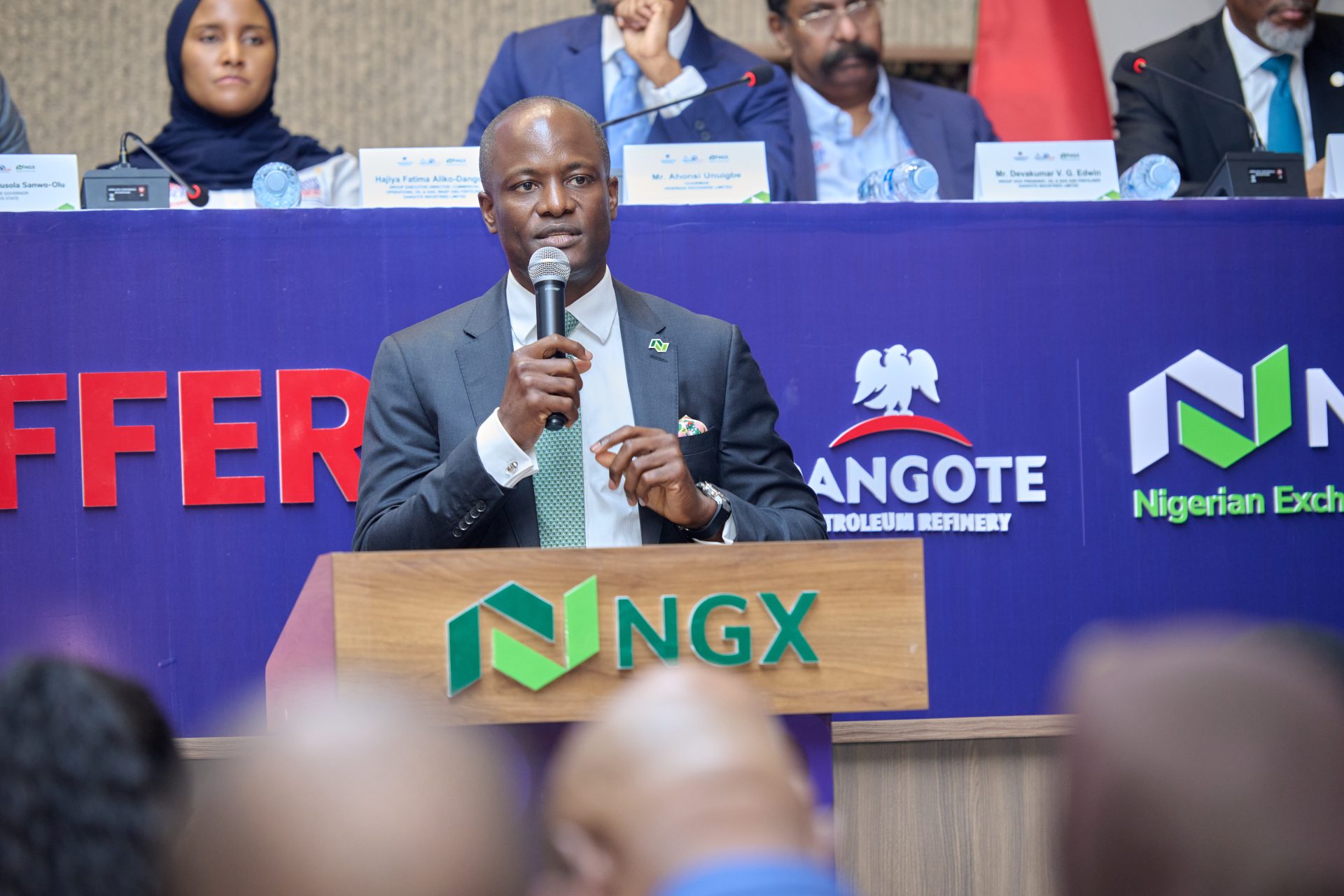
The Managing Director and CEO, NGX Group plc, Mr. Temi Popoola, has said he sees an opportunity to connect Africa’s pools of capital more effectively with businesses across the continent, building on market infrastructure and regional linkages already taking shape.
Africa’s next capital-market opportunity may not lie solely in attracting more money from outside the continent. It may also lie in making better use of the capital already within it.
Across Africa, pension funds, asset managers, financial institutions and individual investors control significant pools of savings, while businesses across the continent continue to require long-term capital to finance growth.
The opportunity, therefore, is increasingly about connecting the two more effectively, across borders, markets and economies.
For Popoola, this is the next important question for Africa’s capital markets: how can the continent mobilise more of its own capital and make it work more efficiently across African markets?
The distinction is important. Foreign investment will remain an important source of funding for African businesses, but a more connected continental market could allow African savings to participate more directly in African growth.
Today, however, Africa’s capital markets remain largely organised along national lines. Investors seeking opportunities beyond their home markets must navigate different regulatory frameworks, currencies, settlement systems, disclosure requirements and distribution channels. For companies, those same differences can make accessing capital across borders more complex.
Addressing these barriers, in Popoola’s view, is part of a larger evolution in how African capital markets need to function, from largely separate national markets towards greater connectivity and participation across the continent.
Building the Connections
The foundations for that evolution are already taking shape through emerging market infrastructure and linkages across Africa.
One example is the African Exchanges Linkage Project (AELP), an initiative of the African Securities Exchanges Association (ASEA) and the African Development Bank aimed at improving access to securities across participating African markets. NGX is among the exchanges involved in the initiative.
The case for greater integration is also gaining support across Africa. Speaking at the Building African Financial Markets Forum in Dar es Salaam in July 2026, Pierre-Célestin Rwabukumba, CEO of the Rwanda Stock Exchange and President of ASEA, put it plainly: “Our markets remain fragmented, cross-border investment is still too limited, too many African businesses struggle to access capital, and millions of our citizens have yet to become investors.” He added that harmonised, integrated markets can improve liquidity, facilitate cross-border investment and give African businesses wider access to capital.
The significance of such efforts goes beyond connecting trading systems. Greater integration and sustainable capital mobility require cooperation across regulation, brokerage, custody, settlement, market information and investor protection. It is an ecosystem that cannot be created by one institution alone.
Technology, however, is helping make the ecosystem more accessible. In Nigeria, NGX Group has been building that capability through NGX Invest, expanding the channels through which investors can participate in public offers and enabling investment opportunities to reach investors through stockbrokers, banks, fintechs and other financial institutions.
For Popoola, these developments point towards a broader principle: capital-market infrastructure should make it progressively easier for investors to access opportunities and for businesses to reach the capital they need. The domestic experience provides a building block. The continental opportunity is to take the thinking further.
From Nigerian Capital to African Capital
Nigeria offers an important illustration of why this matters. As domestic institutional assets, digital distribution and investor participation expand, the question is no longer only how Nigerian capital can finance Nigerian enterprise. Over time, it is also about how stronger market connections can enable African capital to participate more efficiently in opportunities across the continent.
The Dangote Petroleum Refinery and Petrochemicals public offer, launched at Nigerian Exchange on 14 September 2026, provides a significant example of a major African business turning to the capital market to broaden ownership and mobilise long-term capital.
For NGX Group, transactions of this scale also illustrate why the infrastructure connecting businesses with investors matters. The objective is not simply to facilitate individual transactions, but to build a market capable of connecting African enterprises with increasingly broad pools of capital.
Speaking to BBC, Popoola articulated the ambition directly: “We need to be able to mobilize capital across the continent and funnel them, frankly, into whatever businesses in whatever countries that they are to drive our collective growth.”
The proposition is straightforward but significant: an African investor should increasingly be able to look beyond the opportunities available in their own country, while an African business should increasingly be able to access capital beyond its domestic market.
That could be particularly important for businesses operating in sectors requiring substantial and patient funding, including infrastructure, energy, manufacturing, technology, agriculture and financial services.
It could also broaden participation in the growth of African companies. More pension funds, asset managers, institutions and individual investors could potentially participate in businesses operating elsewhere on the continent, creating stronger connections between African savings and African enterprise. The opportunity should not be confused with an already integrated continental market.
The Work Still Required
Cross-border capital flows remain constrained by practical realities. Regulators would need to deepen cooperation. Market participants would need greater alignment around disclosure and listing requirements. Exchanges, clearing houses, custodians and settlement systems must be reliably connected. Investors would need confidence that positions can be entered, settled and exited efficiently across jurisdictions.
Currency risk presents another challenge. Differences in currencies and foreign exchange conditions can materially affect investment outcomes and influence investors’ willingness to participate across borders.
There are also questions of market depth, liquidity and the ease with which investors can repatriate or redeploy capital. These issues matter because connectivity without liquidity, settlement certainty and investor confidence will not, by itself, create a functioning cross-border investment market.
That is why initiatives such as AELP matter. They demonstrate that the work of connecting African markets has already begun, while also showing the scale of coordination required to take that connectivity further.
A Market Designed for African Growth
The opportunity ultimately goes beyond trading volumes. A more connected African capital market could help diversify the funding available to businesses, broaden ownership and enable a greater share of African savings to participate in the continent’s economic development.
The ambition, however, is not for one exchange or institution to build a continental market alone. It is to create the conditions in which African market institutions can work together to reduce the barriers that currently limit the movement of capital across jurisdictions.
For Popoola, the larger opportunity is to build a market architecture in which African capital can move more efficiently to where it can create the greatest economic value, supported by stronger infrastructure, deeper market linkages and greater investor confidence.
The vision is continental. The work, however, will be built market by market, connection by connection.
Culled from ThisDay